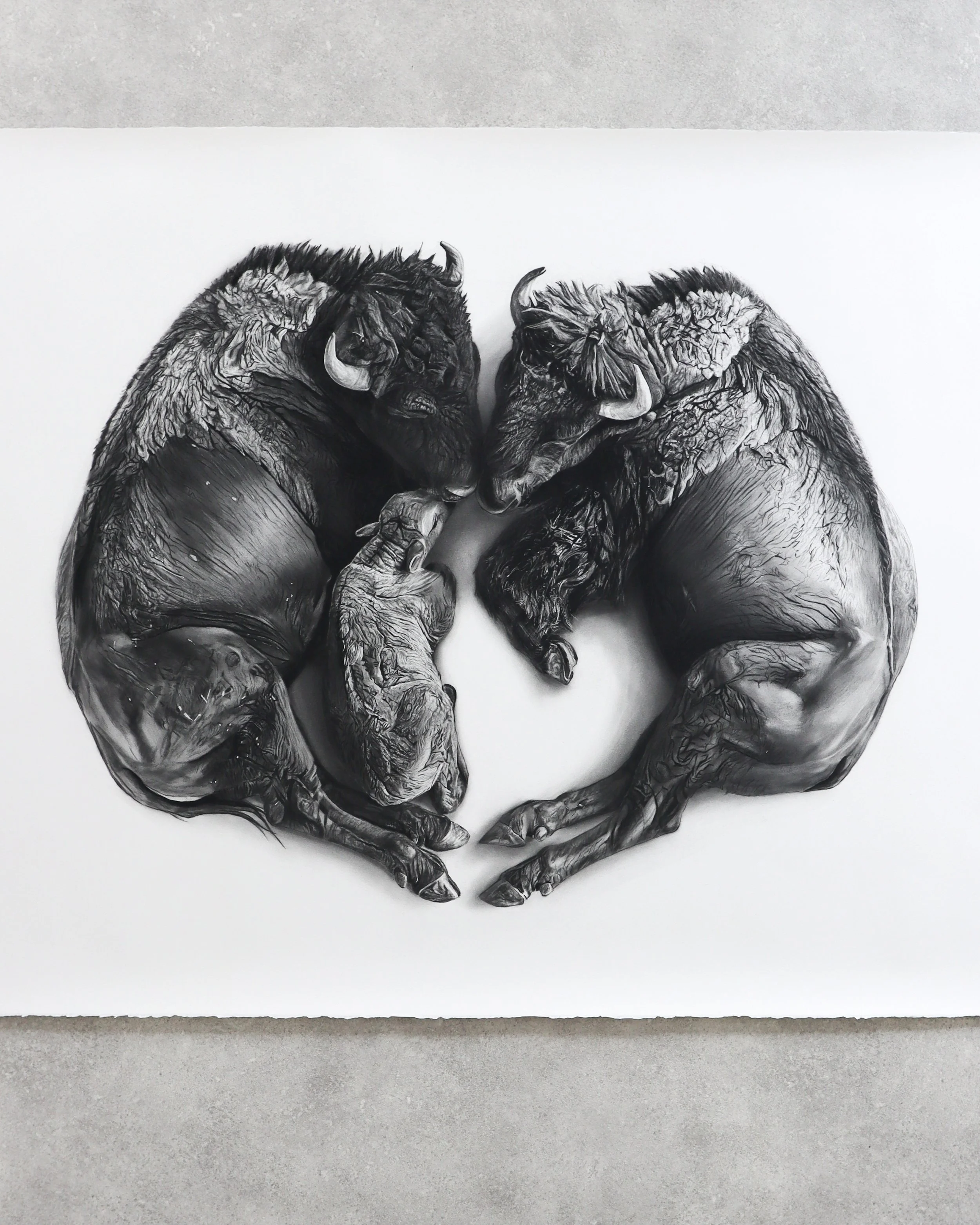
From Idea to Physical presence
Wild Hearts is an ongoing investigation into the shape of the heart, not as a symbol, but as something that can emerge through the relationships between animals.
Wild Hearts begins with an idea, not a photograph.
I am less interested in reproducing moments that have already been photographed than imagining relationships that could exist between animals.
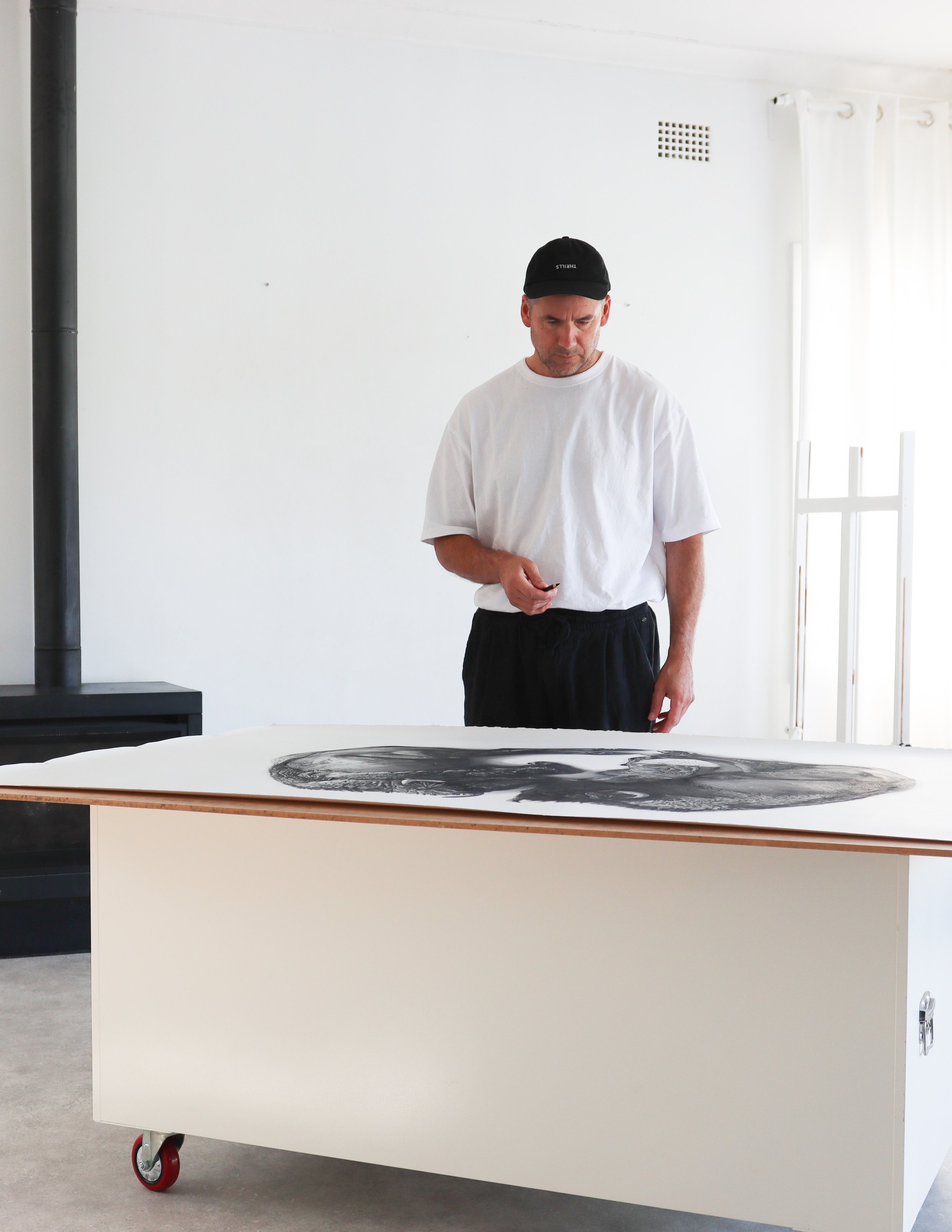
Each work moves through exploration, construction and refinement before being translated into charcoal at full scale.
Digital tools form part of this exploratory process. Adobe Firefly allows me to investigate visual possibilities, while Photoshop allows the composition to be constructed and refined.
The degree of intervention varies from work to work. Some reference provide a strong starting structure, while others are substantially constructed from multiple elements and interactions.
The finished work is always made by hand.
The animals are real. The encounters are composed.
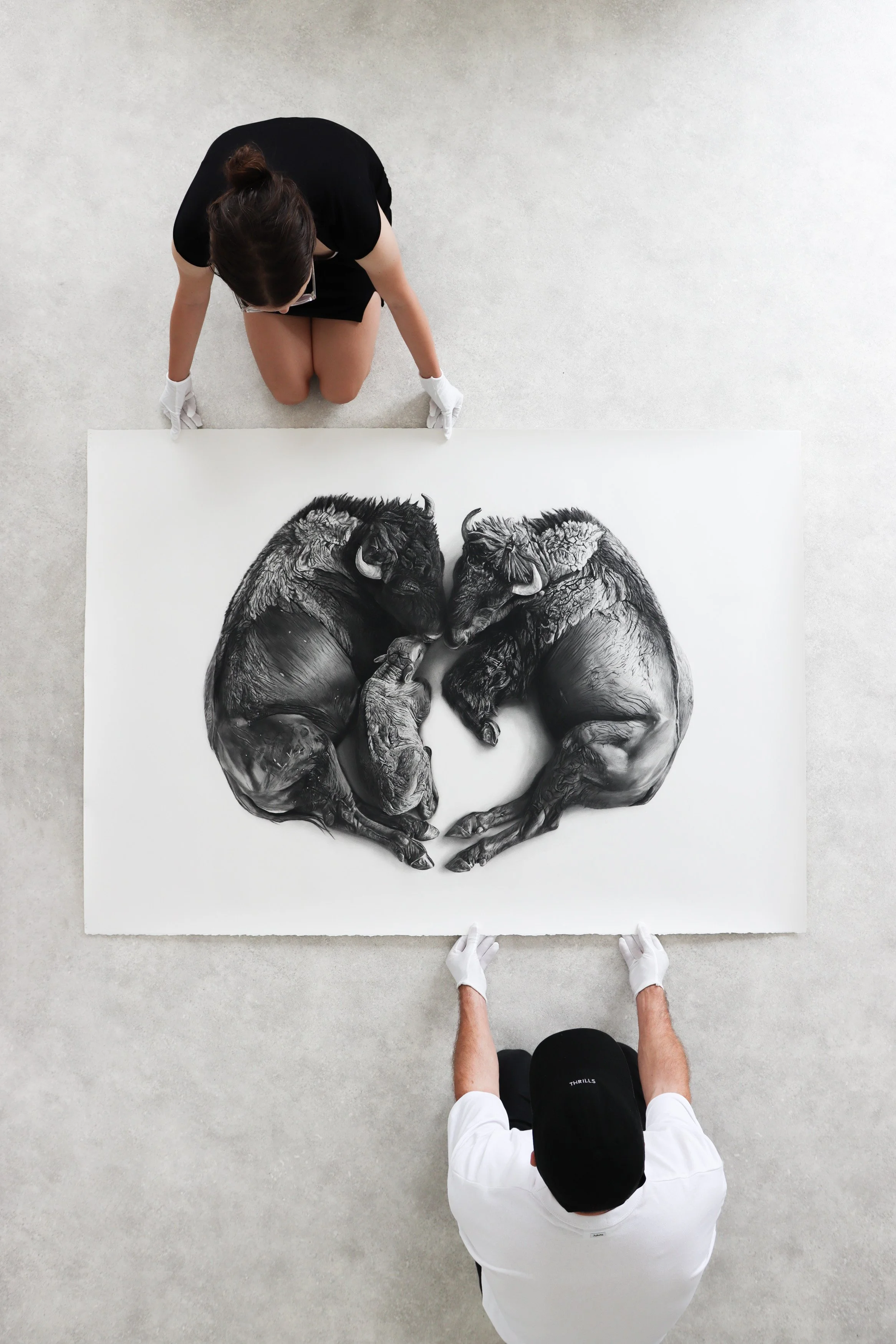
01 — The Idea
The concept comes first.
What if the heart was never invented as a symbol?
What if we simply discovered it in nature?
Wild Hearts is a 15-work exploration of connection, protection and belonging through the relationships between animals.
Each work begins with an idea and emotional premise. The animals, their positions and their relationships are then developed around that premise.
For the Bison work, I wanted the composition to hold an imbalance.
One side would carry greater visual weight through the presence of family and young, while the other would remain more open.
The adult bison would not mirror one another. Their different positions and directions would create an asymmetry within the larger form.
The challenge was to make those unequal parts still belong together.
The heart would never be imposed on the image.
It had to emerge through the relationship.
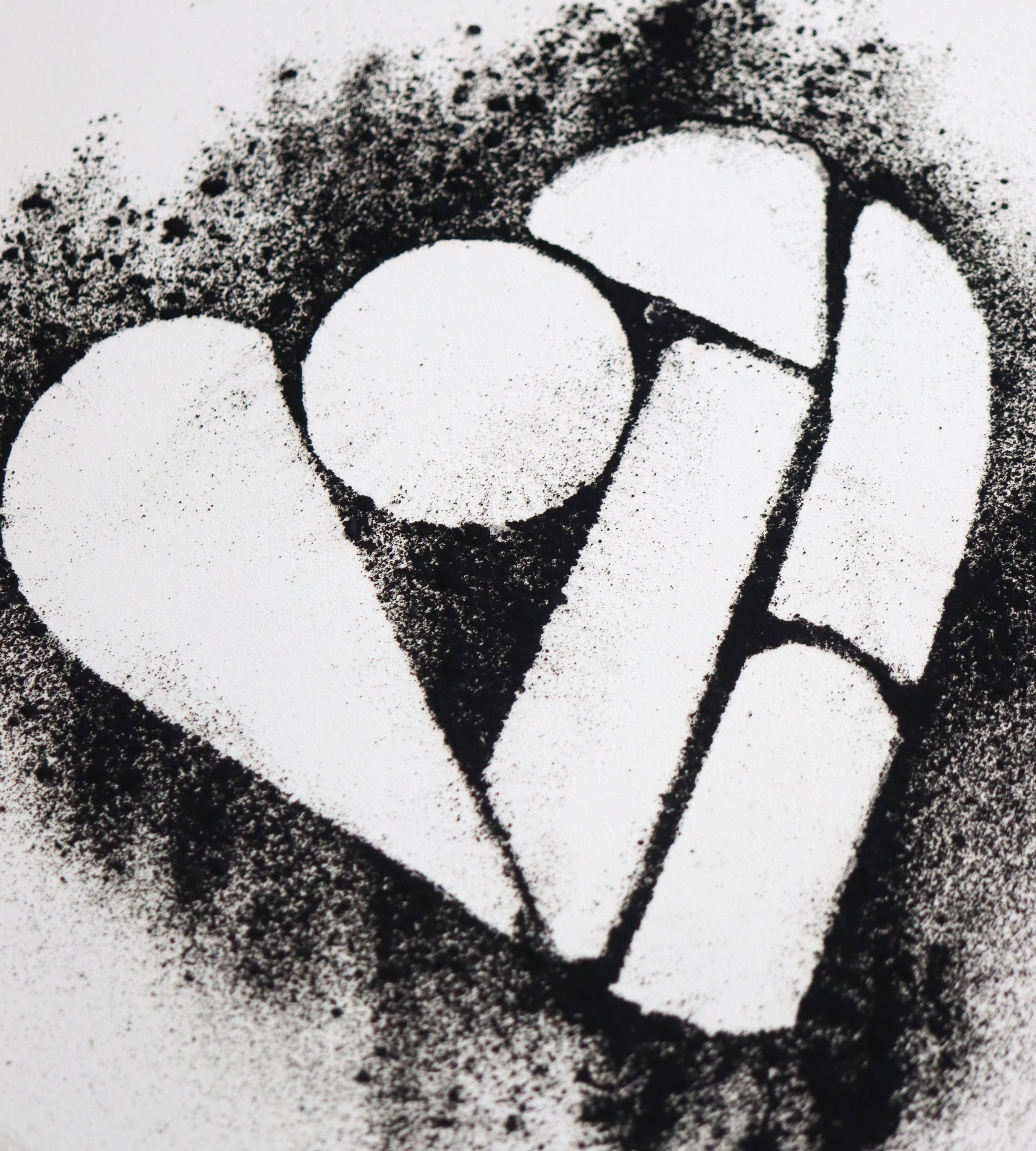
02 — Exploration
Finding the relationship
The first challenge is not drawing the animals.
It is finding the relationship between them.
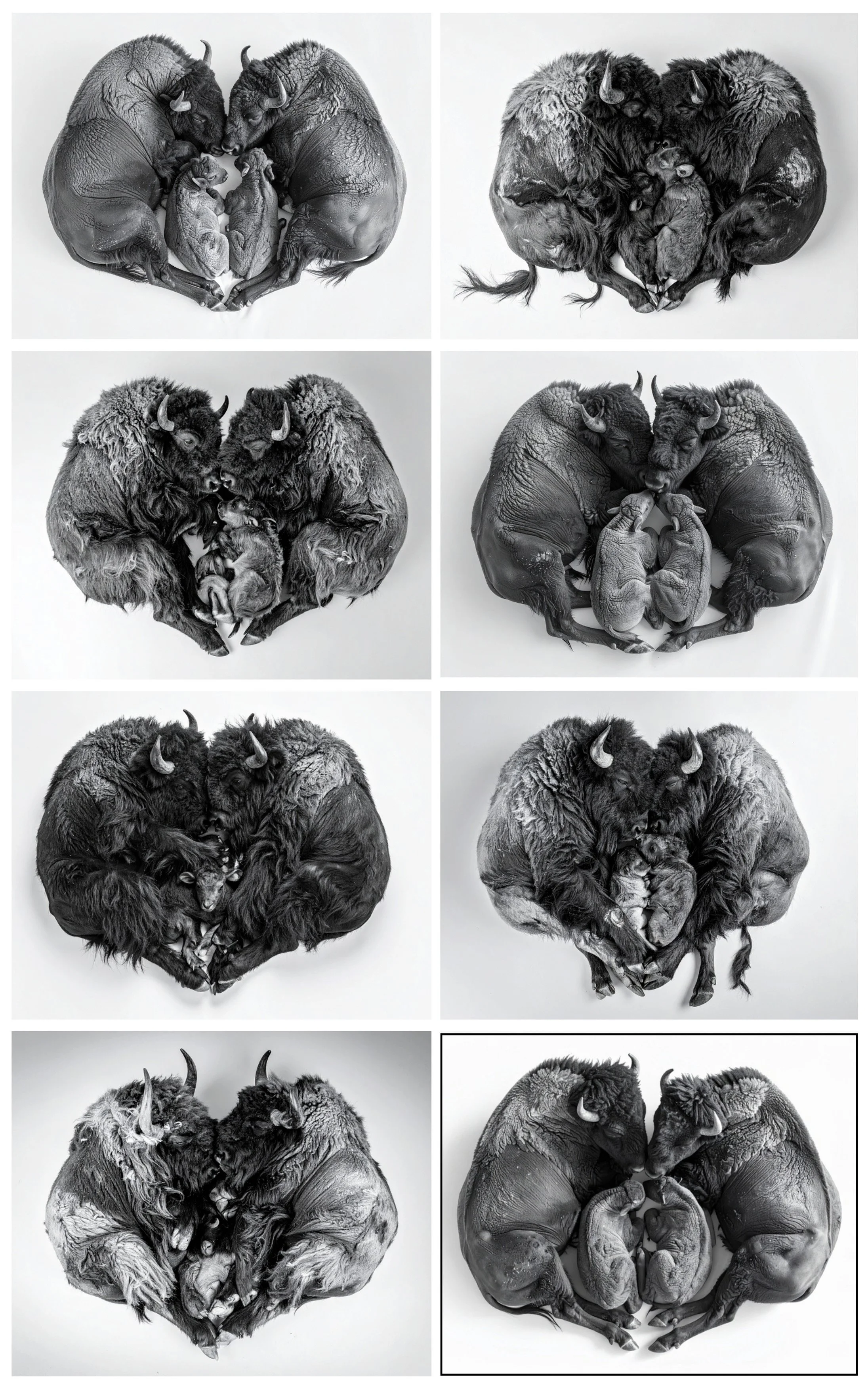
Different animals, positions, perspectives and arrangements are explored to find possibilities that could carry the idea.
Some possibilities work. Others do not.
For the Bison work, I was drawn to the asymmetry between the adult heads. Their different directions created movement and tension within the larger form.
From there, the composition continued to evolve.
Elements were selected, removed and replaced until the relationships between the animals began to resolve.
The composition was not found in a single image. It was constructed through decisions.
03 — Construction
The composition was not found in a single image. It was constructed through decisions.
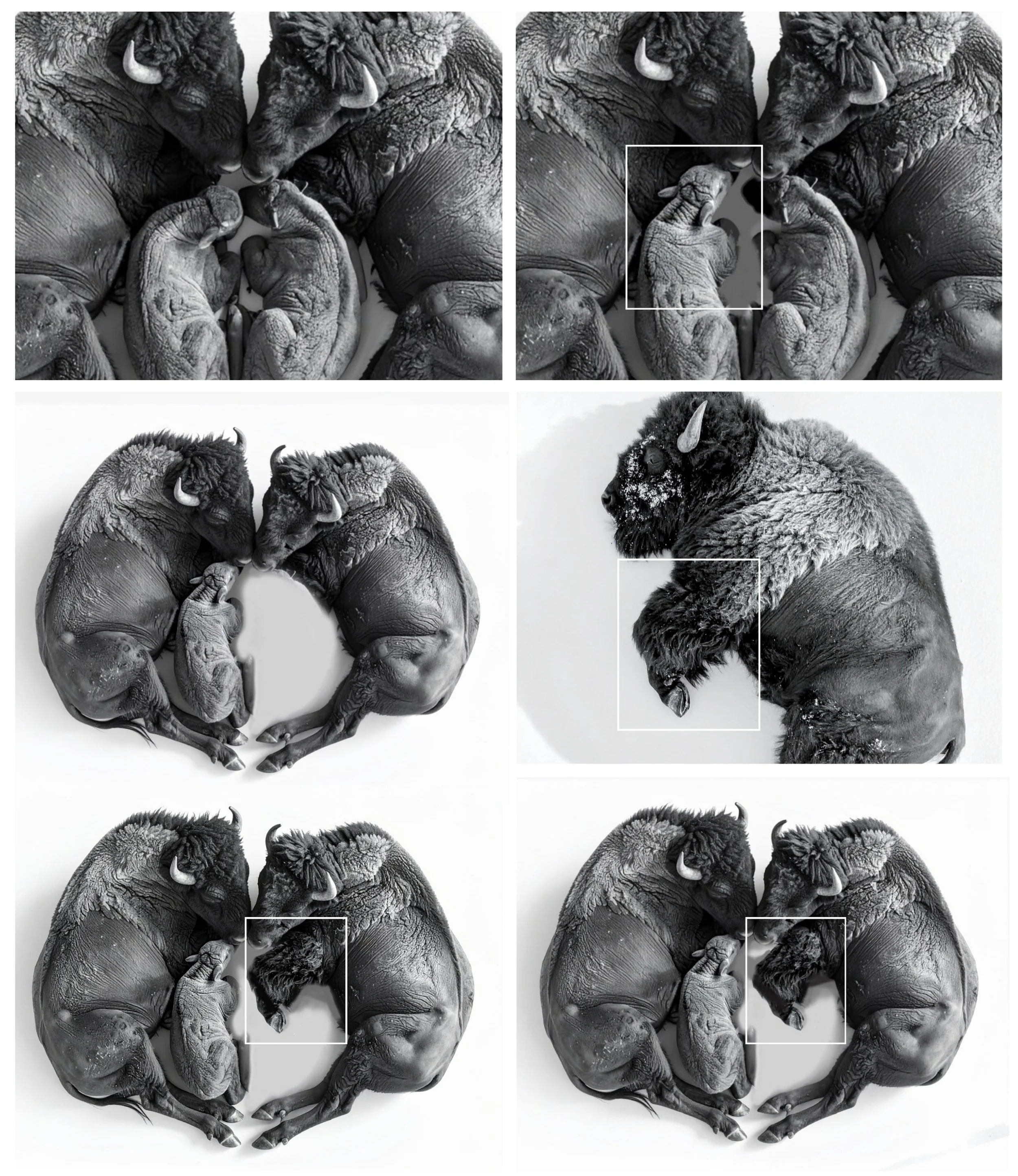
Once a direction is established, the composition is constructed and refined in Photoshop.
Bodies can be repositioned. Heads can change direction. Elements can be removed, replaced or combined from different references.
The degree of intervention varies from work to work. What matters is not how much is changed, but whether the change strengthens the relationship within the composition.
For Wild Hearts, these are not simply technical adjustments.
They are compositional decisions.
04 — The Refinement
When the composition has to resolve
Once the major elements are assembled, I look at the composition as a whole.
Does the balance work?
Does the negative space have enough presence?
Do the bodies relate to one another?
Does the direction of one form lead the eye towards another?
Does the composition still express the original idea?
Elements may be manipulated repeatedly before the relationship feels right.
Sometimes the change is substantial.
Sometimes it is as small as the angle of a head or limb.
For the Snow Leopards, for example, the shape and position of the tails were repeatedly refined so that the larger relationship between the animals could resolve more clearly.
The aim is not simply to create convincing animals.
The arrangement itself has to carry meaning.
05 — The Reference
A blueprint for the drawing
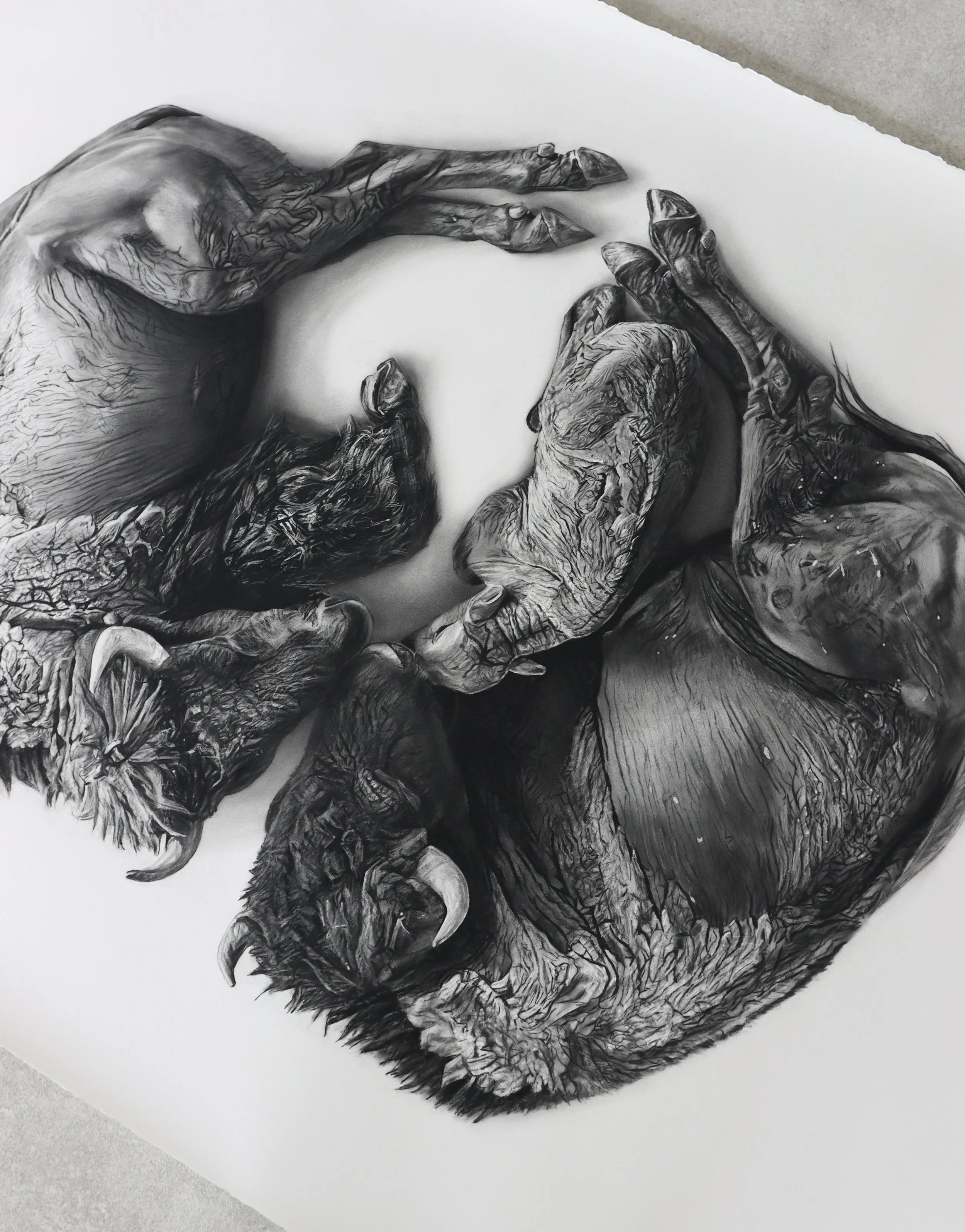
Once the composition has been resolved, the constructed image becomes the working reference for the charcoal drawing.
It establishes the relationships, proportions, lighting and structure that will guide the work at full scale.
The reference is not the artwork.
It is the visual blueprint from which the artwork will be made.
The final composition may have passed through many iterations before reaching this point.
06 — Translation
From reference to drawing
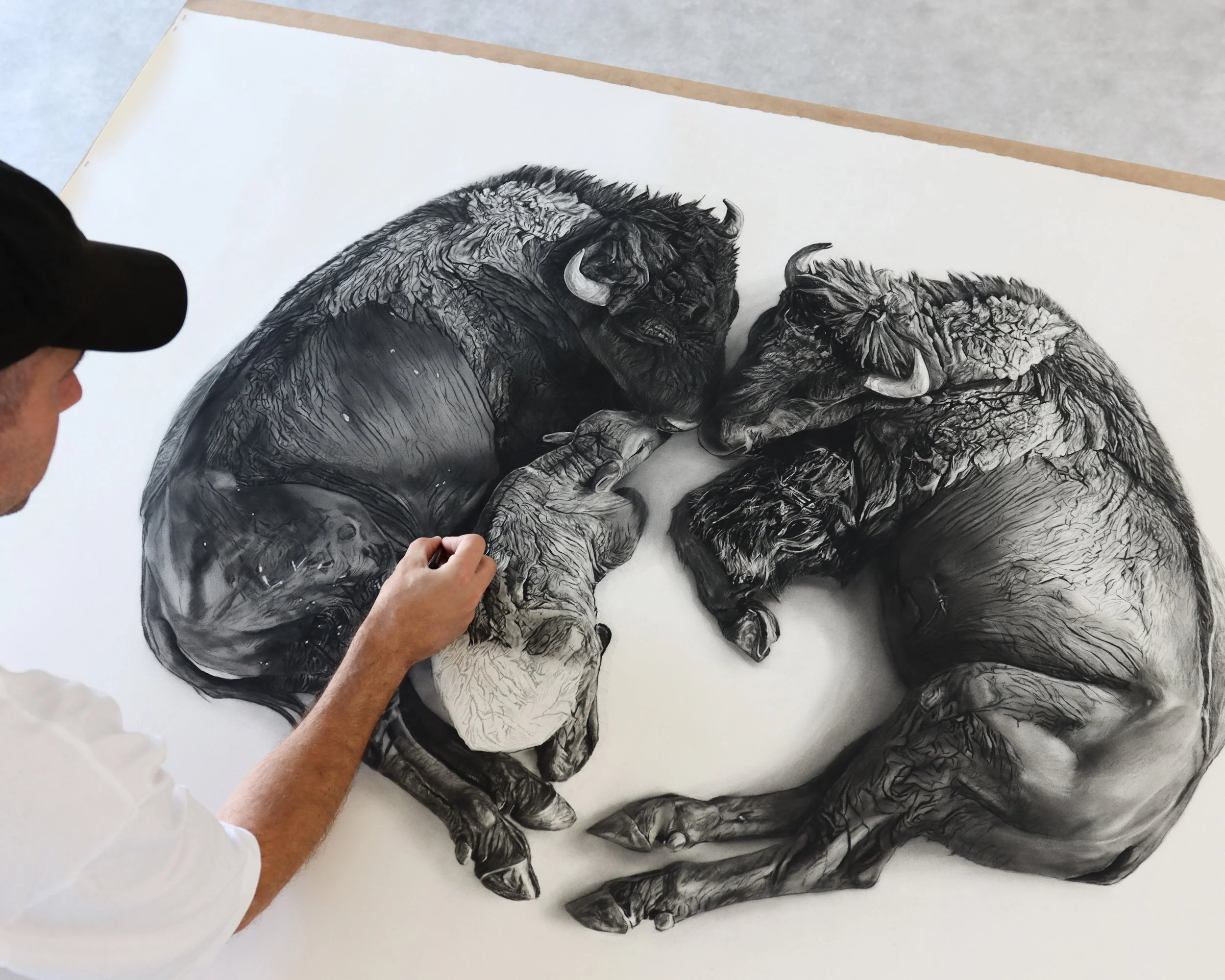
The selected composition is translated into charcoal at full scale.
Each Wild Hearts original is drawn by hand at 160 × 113 cm on Arches Aquarelle Hot Press, a 100% cotton archival paper.
The reference becomes a starting point rather than an endpoint.
Through charcoal, erasure, layering, pressure and thousands of individual marks, the imagined relationship is rebuilt as a physical drawing.
The animals that existed as separate elements within the reference become a single physical work.
An imagined moment becomes a physical presence.
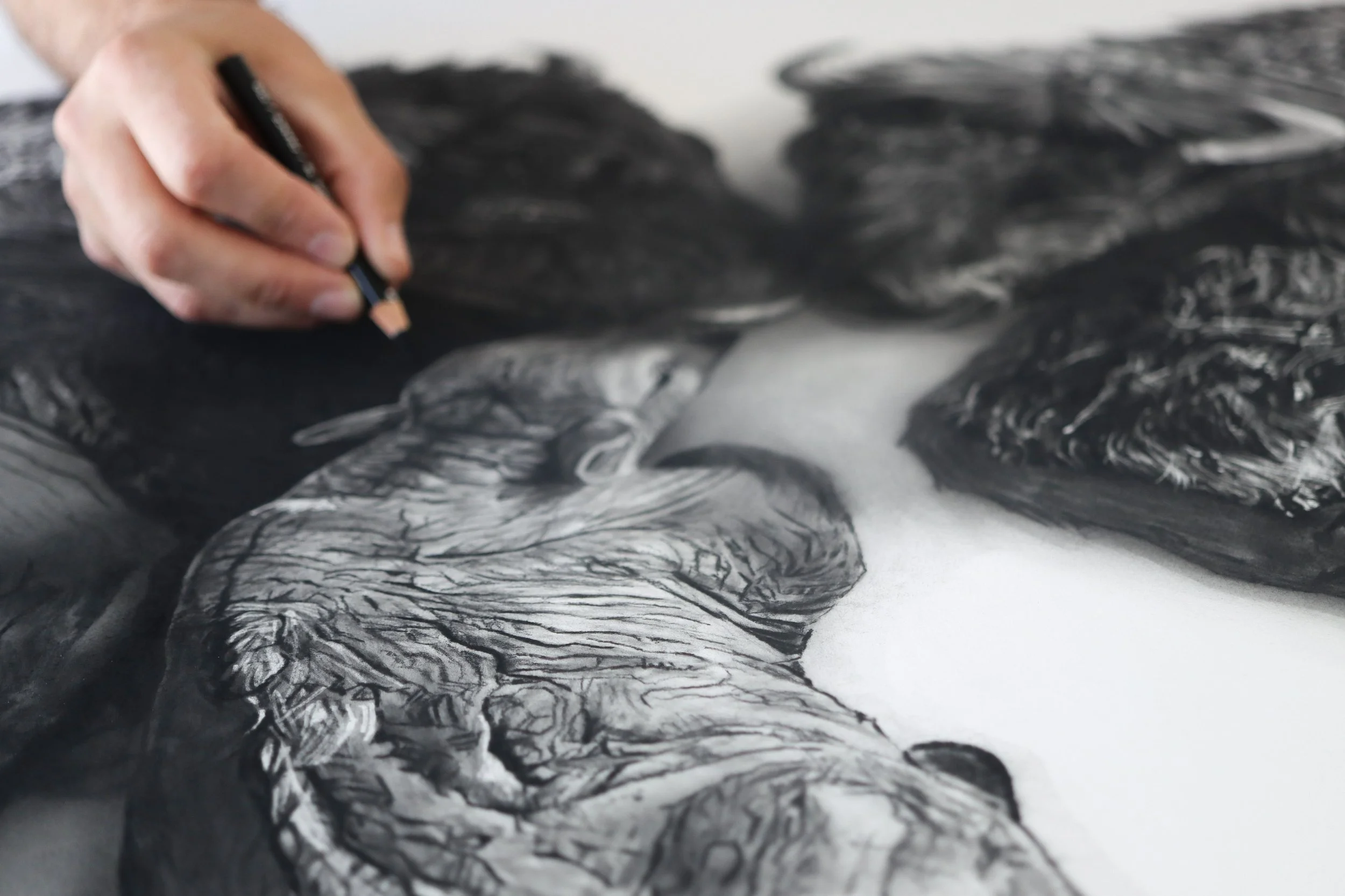
07 — The Hand
Every mark is made by hand.
Charcoal is built gradually through layers of tone, texture and erasure.
Light and shadow create volume.
Texture gives the forms weight.
The surface records the decisions made throughout the drawing, from the darkest passages to the areas where charcoal has been lifted away.
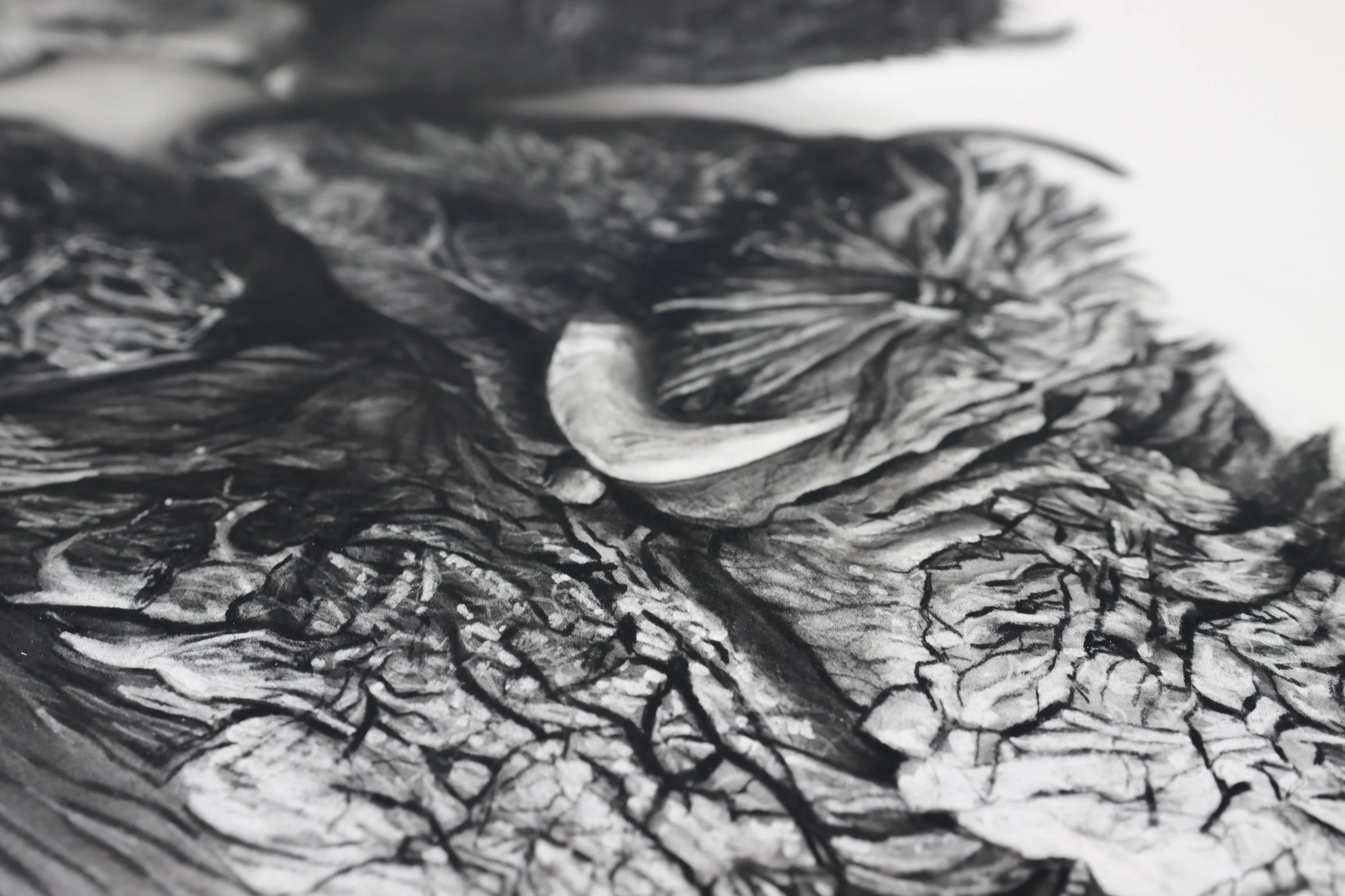
From a distance, the work can appear photographic.
Move closer and the image begins to reveal itself as something entirely physical.
The reference establishes the image. Charcoal gives it presence.
08 — The Reveal
Where the process disappears
The finished work is where the references, iterations and decisions fall away.
What remains is the relationship between the animals.
The viewer first sees the whole.
Then the individual bodies.
Then the marks.
And eventually, perhaps, the heart.
It was never drawn.
It was always there.
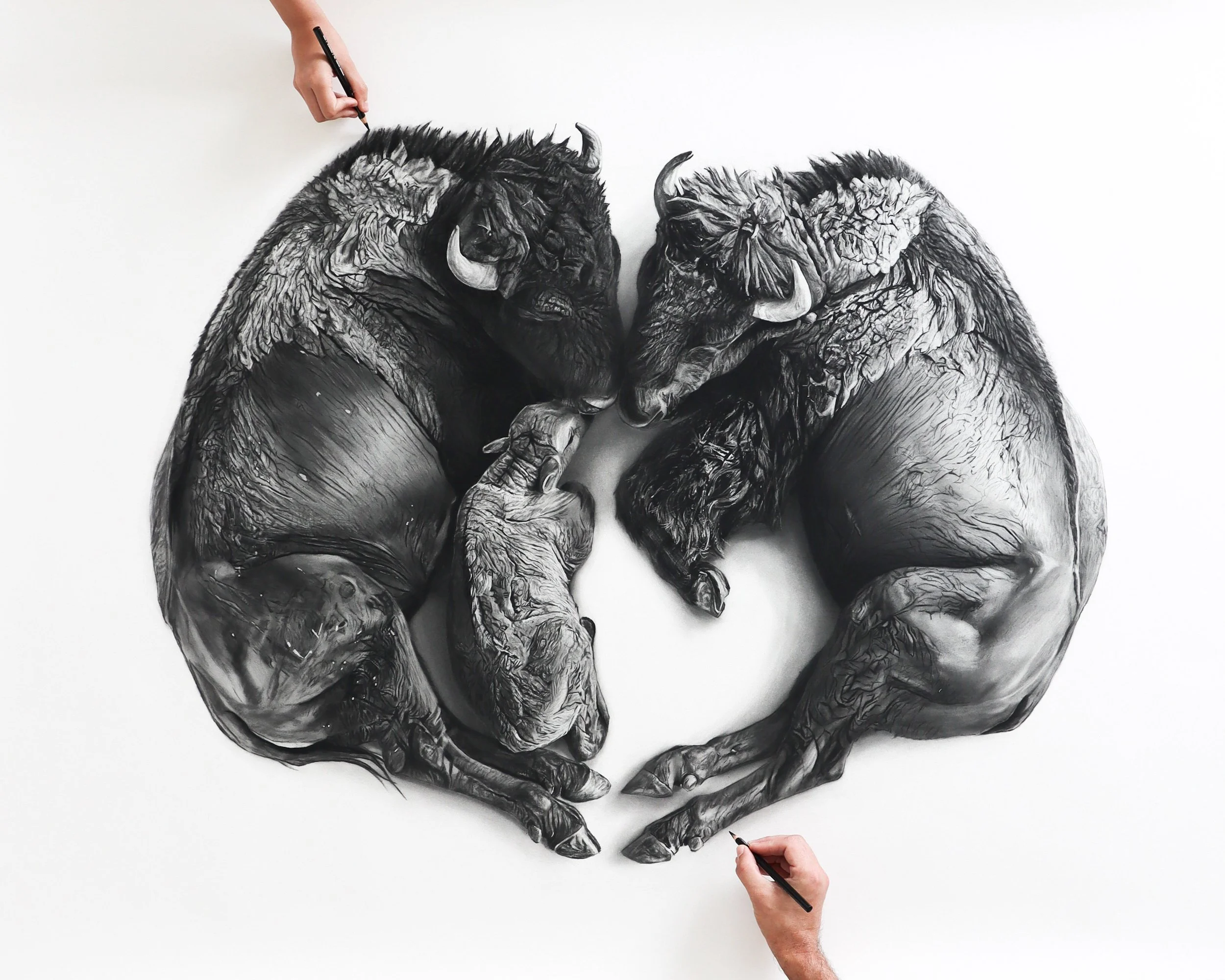
One Practice. Two hands.
Wild Hearts is created by Rob Harris and Georgia Harris through a shared studio practice.
Each work develops through a combination of concept, exploration, construction and drawing.
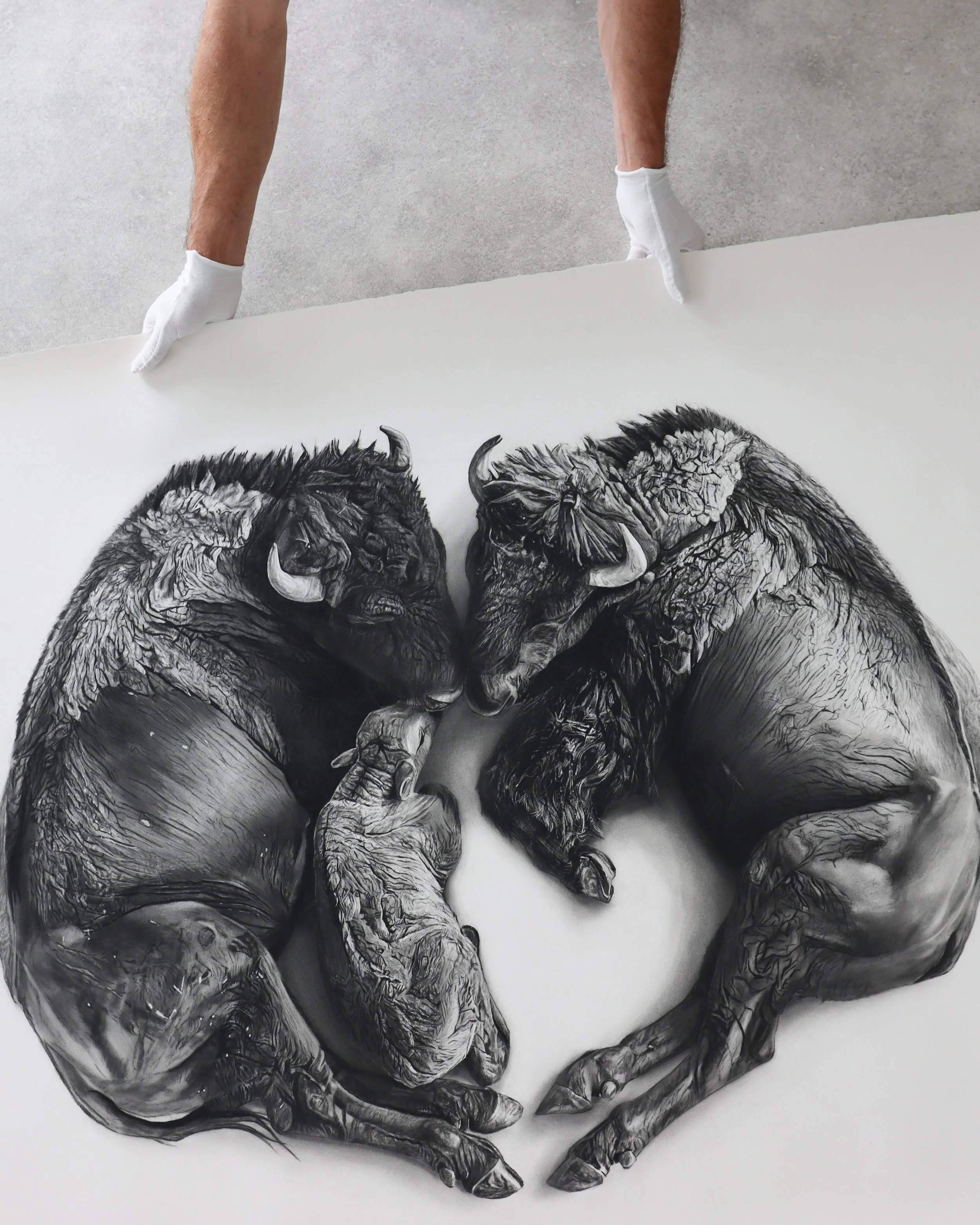
The Material
Arches Aquarelle French cotton paper
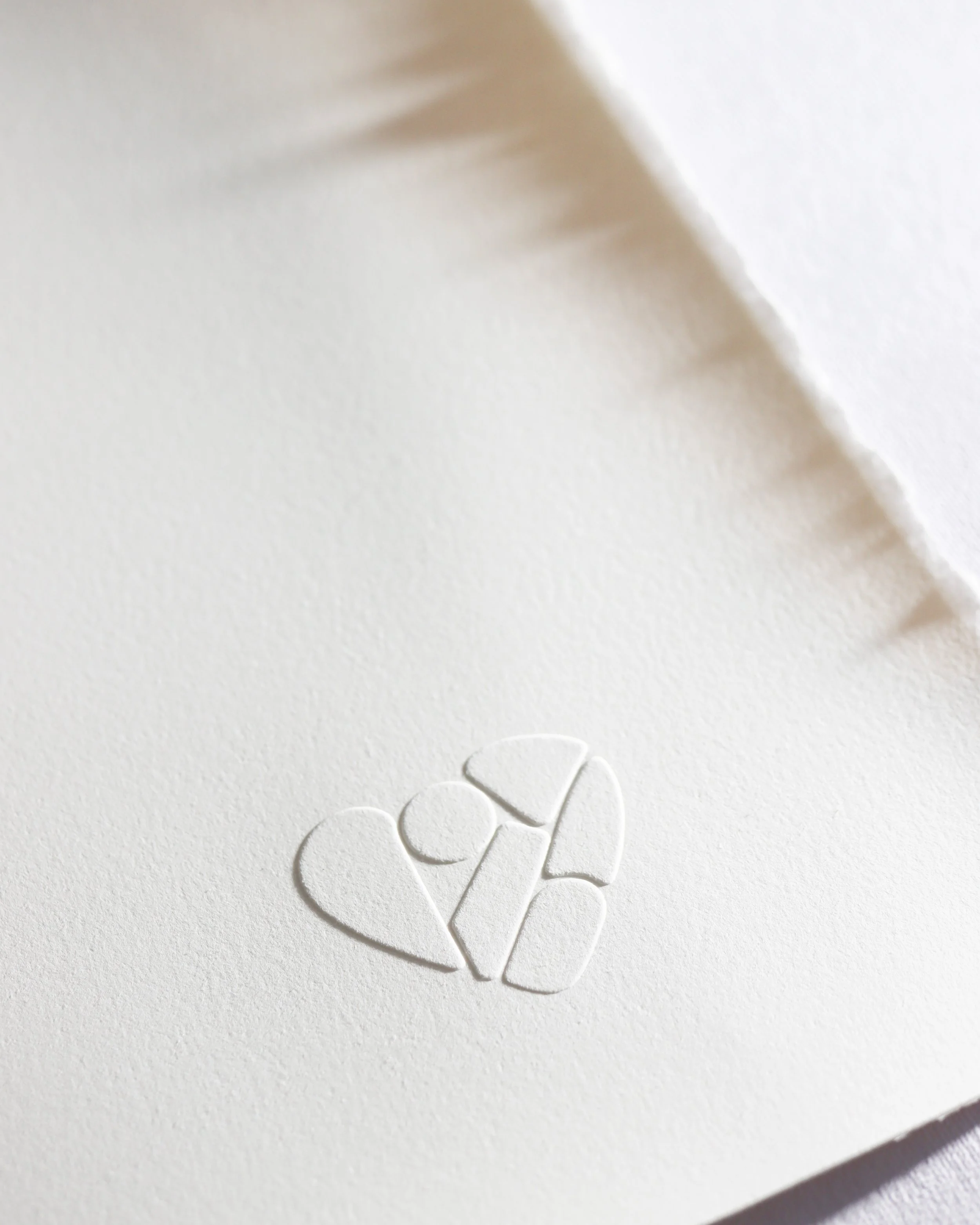
Each Wild Hearts original is created on Arches Aquarelle French cotton paper, selected for its weight, surface and ability to hold the density and subtlety of charcoal.
The natural deckled edge is retained as part of the work, preserving the physical character of the sheet and the handmade nature of its creation.
The paper is not simply a surface for the drawing. It is part of the original.
The Finished Work
From image to presence. From detail to whole.
Wild Hearts is ultimately experienced in person.
At a distance, the animals resolve into a single form.
Move closer and the image begins to break apart into individual bodies, marks, texture and light.
The closer you look, the more physical it becomes.