Wild Hearts
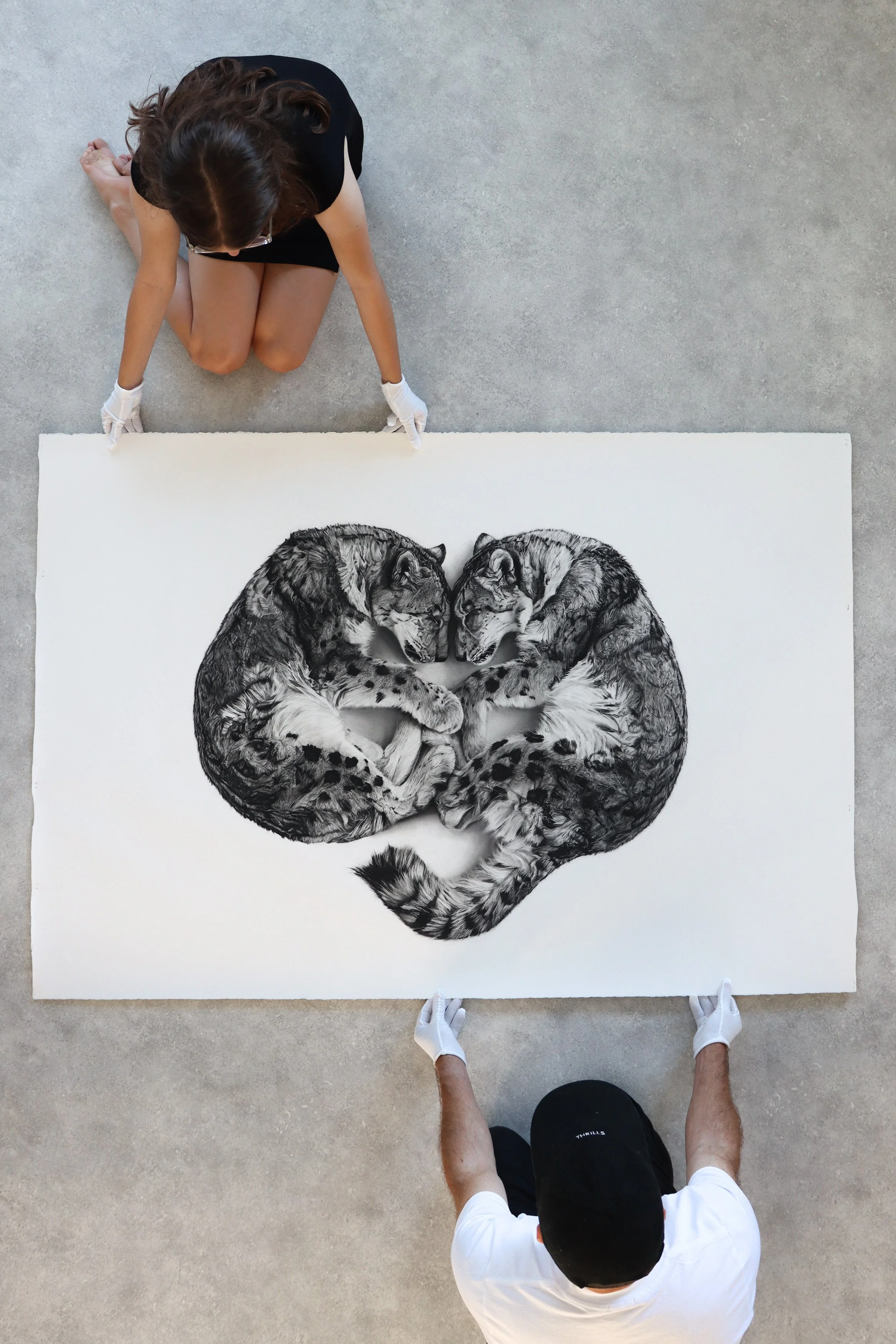
Ghosts
Wild Hearts
A note on the series
There is a point in each work where the drawing stops reading as separate forms.
The animals are still there, observed, constructed, held in charcoal but something shifts in how they sit together. The composition begins to act as a single structure. Not a collection, but a whole. It’s not something that can be forced. It happens slowly.
That threshold sits at the centre of Wild Hearts.
The first work, wolves resolves more quickly. The shape is legible, the structure clear. It holds together with less resistance. It was important to begin there. From that point on, the work has moved in a different direction.
Subsequent pieces ask more of the viewer. The forms are still precise, still grounded in observation, but the resolution is less immediate. The relationships between bodies carry more weight. Edges compress. Negative space does more of the work. In some pieces, the structure only fully resolves with time.
The heart is not imposed. In some works it is visible. In others it sits just out of reach, implied through proximity and pressure rather than outline. The series moves between those states deliberately.
What holds the work together is not the motif, but the way the forms behave. Mass against mass. One body yielding to another. The quiet geometry that appears when living things gather closely enough that their boundaries begin to blur.
Seen in person, the drawings are often described less as images and more as objects. There is a physicality to them, a sense of weight and containment that sits somewhere between drawing and sculpture. That quality matters. The work is not trying to describe these animals. It is trying to hold them.
Six works are complete. Each one drawn at scale, each one arriving at its structure differently. The series continues.
If the work has found you, I’m glad.