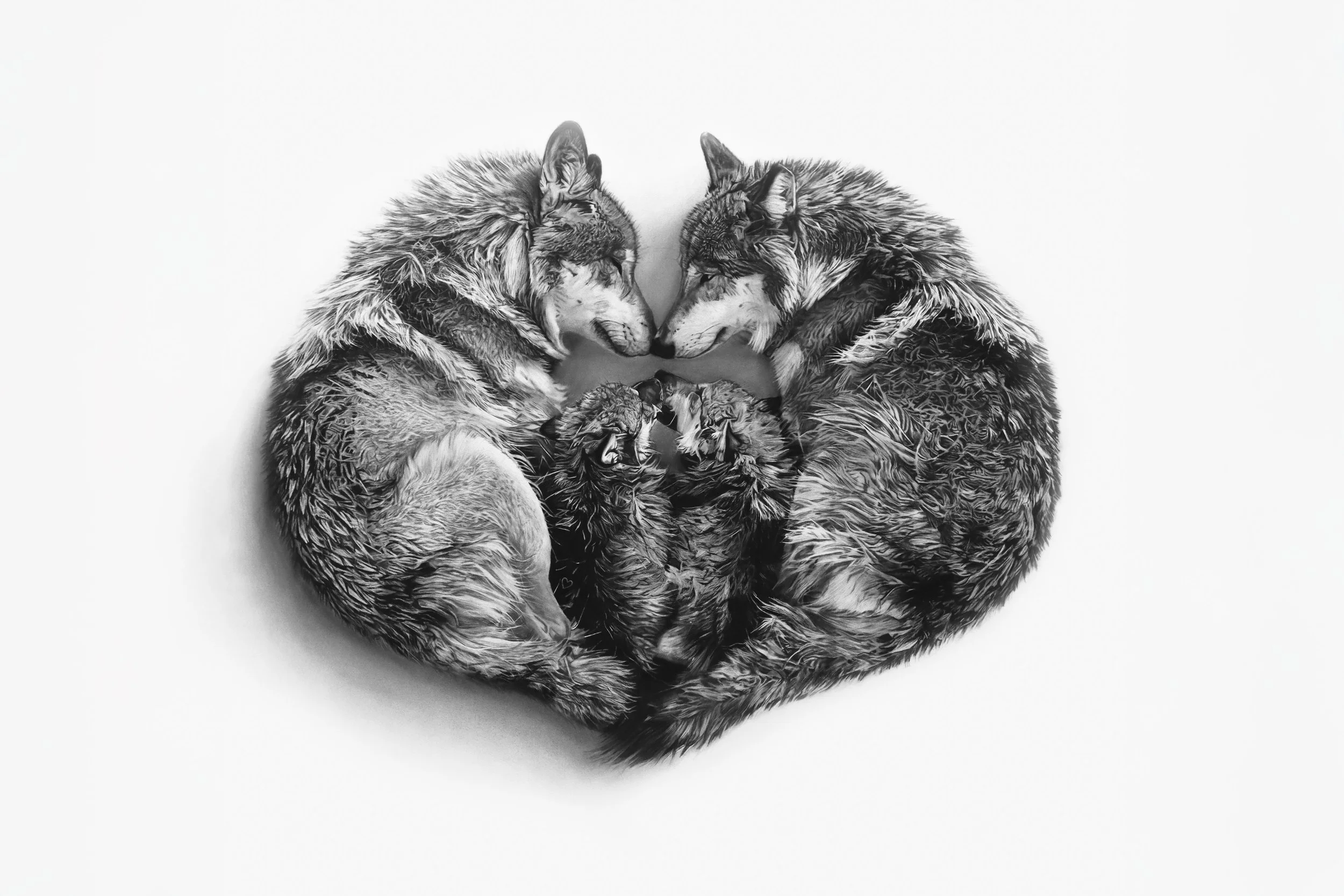
Wild Hearts
Introduction
For the past few years, much of our work has explored intimacy at a restrained scale. Sleeping babies curled inward. Bees given quiet personalities and human-like presence. These works were designed to invite viewers closer, encouraging stillness, care and attention.
Wild Hearts marks a shift.
Not away from intimacy, but toward presence.
This new body of work focuses on family units in the wild and the invisible forces that hold them together. Protection. Unity. Connection. These ideas have long underpinned our practice, but with Wild Hearts they demanded more physical space, more time, and a different kind of engagement.
Why Wild Hearts
Wild Hearts began as a question rather than a statement. How do you depict connection without sentimentality? How do you show protection without aggression? And how do you allow symbolism to exist without overpowering the subject itself?
Early in the development of the series, we became interested in the heart as an organising form. Not as an icon or a motif to be placed on the work, but as a structure that could be built from proximity, balance and instinctive care. The idea was simple in theory and difficult in practice. The heart needed to exist quietly, formed by the family unit itself rather than announced through design.
From there, each composition was deliberately constructed so that anatomy, negative space and movement worked together. The goal was always restraint. If the heart became obvious, the composition had failed.
Finished work: Wild Hearts Wolves
Composition as a discipline
Composition has always been central to our practice. In both Baby Paws and Cool Bs, we drew heavily on principles of balance drawn from the Fibonacci sequence and the golden ratio. These were never used as rigid formulas, but as guides for creating harmony, calm and a sense of inevitability within the frame.
Those same principles carried into Wild Hearts, but at a far greater scale and complexity.
Here, composition became the bridge between intentional symbolism and natural anatomy. The challenge was to allow the heart form to emerge through proportion, proximity and negative space, while still feeling instinctive and true to the animals themselves. Many early compositions were technically correct but emotionally wrong. It took time, iteration and rejection to arrive at structures that felt resolved, where the symbolism sat beneath the surface rather than on top of it.
The heart is one of the most universal symbols in the world
The decision to work at Gallery scale
The move to double A0 scale was a considered decision.
At 160 × 113 cm, these works are no longer encountered casually. They require physical presence. The viewer’s distance from the work matters. Detail behaves differently. White space becomes active rather than passive.
The scale is not about spectacle.
It is about presence.
Working at this size allows intimacy to operate in a different register. The viewer does not lean in. Instead, the work holds its ground, offering a sense of quiet authority that smaller formats cannot.
Top down shot of work sized at 160cm x 113cm
Materiality and restraint
Each Wild Hearts piece is drawn on museum-grade Arches French cotton paper, selected for its strength, texture and longevity. We work within the natural roll width of the paper, allowing the deckled edge to remain intact. This edge is not decorative. It is a visible reminder of material honesty and process.
Charcoal at this scale demands discipline. Every mark carries weight. There is nowhere to hide. The white of the paper is as intentional as the drawn surface, and restraint becomes an act of respect, both for the subject and the medium.
Archers paper with deckled edge and floating mount frame
Wolves: The beginning
The first completed work in the series features a wolf family.
Wolves are defined by their social bonds and collective responsibility. In this composition, the parents form a protective outer structure, their bodies creating a subtle heart shape that shelters the pups at the centre. The image is not about dominance or threat. It is about strength expressed through care.
This work became the foundation for the series, setting the emotional and conceptual tone for what follows.
Creating it together, the parallels between subject and process were impossible to ignore. Wild Hearts is not only about the families we depict in the wild, but about the relationships that shape us as artists.
Babies nestled between parents conveying protection
Conceptual fine art and symbolism
Wild Hearts sits within a conceptual fine art framework.
Each species is chosen not simply for its visual appeal, but for what it represents. The compositions communicate meaning through form, balance and negative space rather than narrative explanation. Symbolism is present, but not overly explicit.
The heart is not an icon. It is a consequence of connection.
Viewers are invited to bring their own experiences of family, protection and belonging to the work, completing the meaning for themselves.
A shared practice
Our collaboration remains at the core of this series.
Working at this scale has deepened that partnership. Decisions carry more weight. The process is slower and more deliberate. Patience becomes essential. Wild Hearts is as much about how the work is made as what it depicts.
Dad and daughter at work
Looking ahead
With the wolves complete, the second Wild Hearts piece is now underway. Elephants, with their deep familial bonds and generational memory, are beginning to take shape on the paper, revealing a different energy and rhythm. Beyond them, orangutans are planned, a species defined by care, intelligence and connection.
Wild Hearts is not a fixed series. It will unfold over time, guided by meaning rather than schedule.
This body of work represents a new chapter in our practice. One that honours where we have come from, while allowing space to work at greater scale, with greater intent, and with a quieter confidence.